Technology Strategy
AI works in demos. Running it is the hard part.


Artificial intelligence has dramatically accelerated the speed at which software can be imagined, prototyped, and shipped. Teams can now generate interfaces, draft flows, and assemble working applications in a fraction of the time it once took to move from concept to clickable prototype.

Yet, as Martin Sandhu observes in his article "Vibe Coding: Why Your AI-Built App Has No Users", many AI-built products fail not because teams cannot ship quickly, but because speed of execution is mistaken for product-market understanding. Faster software delivery does not automatically mean a better understanding of what users need, when automation is appropriate, or how trust should be maintained once an AI agent begins to act inside a workflow.
This is where user intent becomes the missing link: unless we clearly understand what users are actually trying to achieve, we cannot reliably turn AI speed into business outcomes like faster decisions, lower operating costs, or reduced risk. When we design directly from user intent, every autonomous workflow has a measurable purpose.
The next wave of digital products will be centered on autonomous workflow experiences. Unlike traditional software, where users must manually navigate interfaces and coordinate each step of a process, autonomous workflow experiences use AI agents to understand goals, gather context, recommend actions, and complete parts of the work on the user's behalf.
In these environments, AI agents interpret user intent, assemble context, suggest actions, and in some cases execute work directly. The business appeal of it all is obvious: complex processes can move faster, and experienced professionals can spend more time assessing options and less on managing coordination. However, as the team at Shakudo points out in their analysis of AI agents in regulated industries, autonomous systems create value only when they are designed with appropriate controls, oversight mechanisms, and escalation paths. Imagine the impact on the business if an AI agent acts with confidence without being designed for clarity, control, and escalation.
In that scenario, user intent is still present, but it is being interpreted in opaque and unreliable ways, which turns potential impact into new operational and compliance risk instead of measurable value.
The vast majority of users perceive AI agents as autonomous authority figures. The expectation is that they would immediately understand what the user is talking about, respond with confidence, and come up with the best possible reply. Product and engineering teams know that is not the case: a reliable AI agent does not emerge automatically from a capable model. Dependable behavior is the result of product decisions, prompt design, agent orchestration logic, failure handling, permissions, escalation paths, and deliberately designed opportunities for human-AI collaboration.
What looks like effortless competence on the surface is usually the result of substantial design and engineering work underneath.
Agentic UX design is the discipline of designing how AI agents interpret intent, make decisions, communicate uncertainty, and collaborate with humans. Its goal is to turn technological capability into autonomous workflows that users can understand, trust, and use effectively. As discussed in UX Collective's article on the shift from human-centered design to human-centered AI, in practice, it positions the designer as a mediator between the system and the human being using it: between what the technology can do, what the business wants to automate, and what the user can realistically rely on in a high-stakes environment.
Put simply: Agentic UX design starts from user intent, shapes how agents act on that intent, and in doing so determines whether AI shows up as meaningful business impact like shorter cycle times, fewer errors, and higher adoption, or just another layer of complexity.
Traditional software design relies on the user to take the bulk of the cognitive load required to complete tasks of various complexity. Users learned where information lived, how to navigate the UI, which sequence of screens to complete, and where approvals or handoffs would occur. Good UX reduced friction, and even if it could design relatively personalized experiences, it still relied on the user to carry much of the operational burden in order to get a meaningful outcome.
AI-native interfaces rely more on human-AI collaboration, where the AI agents do the heavy lifting by interpreting goals, gathering data, preparing outputs, and adapting the workflow based on the identified user intent. What is left for the user is to take an informed decision, without having to go through time-consuming and information-heavy processes.
When intent is mapped correctly, each handover from user to agent and back is intentional: the agent takes on what machines are best at (aggregation, pattern-spotting, orchestration), and the human stays focused on high-value judgment. That is the direct path from “better intent understanding” to “higher-value time” and therefore to business impact.
The introduction of autonomous workflows, however, does not eliminate the need for design. Instead, it moves the design deeper into the product and broadens its manifestation in the software development process. Concerns like navigation, responsiveness, and detailed user flow mapping are left for the agent to take care of. Designers now help shape how the agent behaves, how much autonomy it should have, how it communicates uncertainty, when it should ask for clarification, and how users remain in control when the system reaches the edge of its competence.
In the regulated industries, the quality of the experience cannot be separated from risk, accountability, and oversight. Let’s take healthcare, for example: a clinician does not need a system that simply displays more information faster. They need a system that reduces cognitive overload, surfaces the right context with a high level of confidence, supports decision-making, and makes its own boundaries obvious when it cannot proceed safely. The more users are expected to safely rely on AI agents, the more deliberate the design of their boundaries and the way they communicate uncertainty must be.
In this context, intent that is not safely channeled can actually increase risk. Agentic UX design ensures that clinical intent is expressed, interpreted, and constrained in ways that protect both the user and the organization, which is precisely where business impact and compliance meet.
A common misconception in the current AI cycle is that design has become optional because models and code generation tools can produce aesthetically pleasing, trendy, and user-friendly interfaces at speed. In reality, AI has not removed the need for design in its classic meaning “to devise for a specific function or end.” Instead, it has provided the opportunity to compress the time window in which the design must do its job well. Teams can generate an application faster than ever, but they can also ship misunderstandings faster than ever if they do not account for real user intent and behavior, domain expectations, and the social dynamics of trust.
Agentic UX design needs to be understood as part of the software development process itself, not a phase that comes before or after engineering. In traditional software projects, design often precedes implementation. In agentic systems, however, experience and behavior are shaped alongside the underlying architecture. Developers define the tools, permissions, and data flows that power automation, while designers define how those capabilities meet user intent.
In agentic UX, the designer not only makes sure that a warning message appears in the right place and time, using the semantic amber color and triangle with an exclamation mark that users recognize and understand at a glance. Now it’s the designer’s job to make sure autonomy is introduced when and where it creates value rather than confusion, that the system remains legible as it acts, and that the user is prompted to intervene when human expertise must take over. Agentic UX is a design-and-build discipline where behavioral logic and user experience are developed together.
The real value of AI does not come from how quickly a team can ship a prototype. A fast proof of concept demonstrates the technical possibility. A well-designed agentic workflow demonstrates operational readiness. The difference between the two is often the quality of the design work that connects technical capability to the reality of the user’s job.
When that connection is done well, you can literally trace a line from “intent” to “impact”: clearer intent leads to more focused automation, which leads to fewer steps, fewer handoffs, and fewer errors; outcomes that show up in throughput, cost per case, and satisfaction scores.
As AI-native interfaces increasingly become part of human-AI collaboration, design teams start to produce deliverables that go beyond traditional wireframes, user flows, or content guidelines. Classic UX tools still matter, but they are no longer enough to describe how AI agents should behave.
The fundamental deliverables that make agentic UX design concrete and actionable for cross-functional teams are Intent Maps, Failure-Mode Taxonomies, and Prompt & Reasoning Specs.
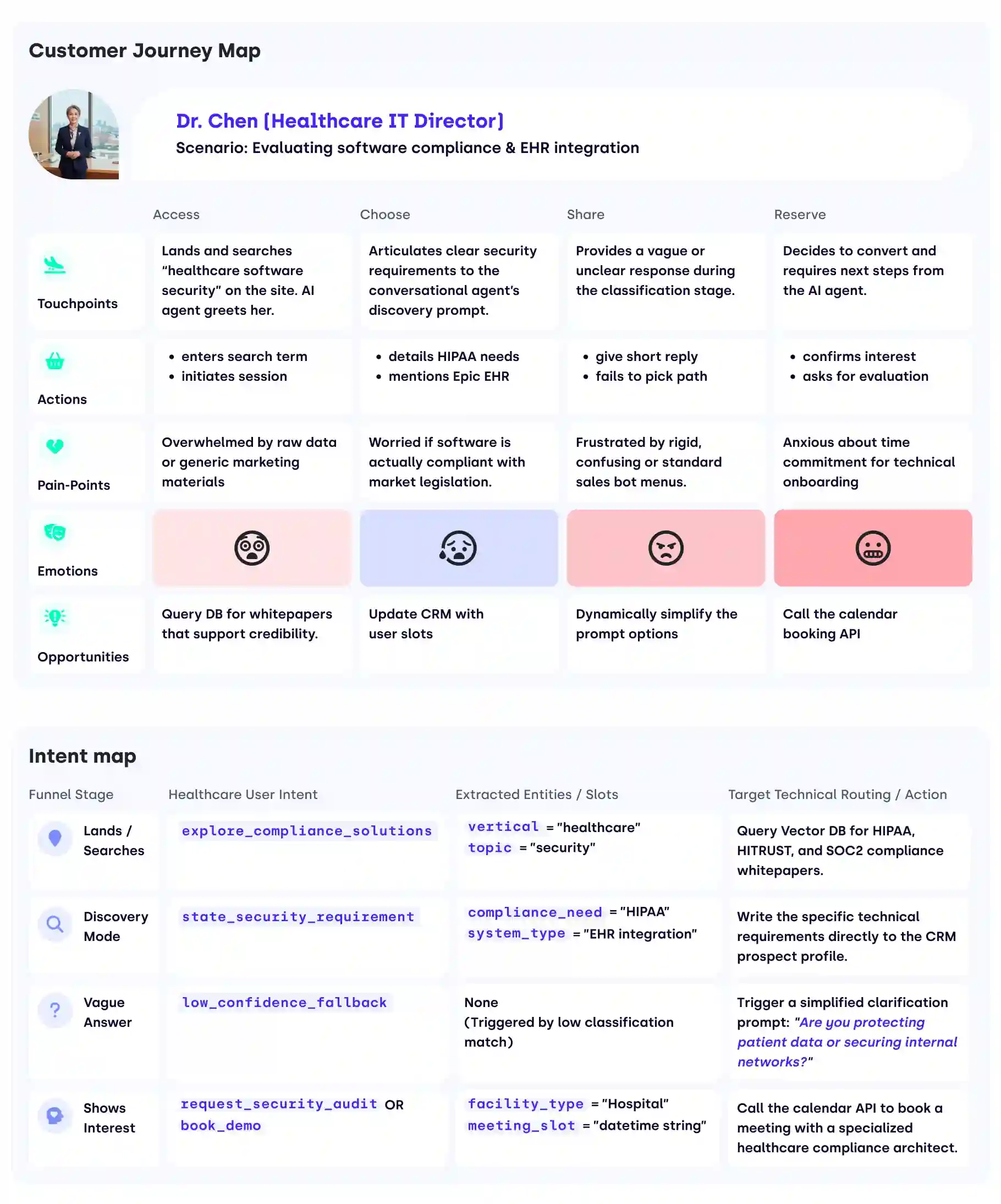
Customer journey maps are used to help teams understand the sequence of possible touchpoints, decisions, and pain points users experience while trying to achieve a goal. But when AI agents enter the picture, the journey alone is no longer sufficient. A journey map focuses on the user, their emotions, environment, and actions while interacting with an interface. The journey map does not fully explain what the system is meant to understand, when it should act, what information it needs, or where its autonomy becomes unsafe.
An Intent Map builds upon the logic of User Journey Maps. It focuses not only on steps, but on goals, decisions, dependencies, and authority boundaries. It maps:
what the user is trying to achieve,
what the agent is responsible for,
which data or tools it needs,
where it can act autonomously,
where it should ask for confirmation,
and where it must escalate to a human.
A traditional User Journey Map might show how a clinician reviews patient history, searches for data, prepares a consultation, and documents next steps. An Intent Map reframes that workflow around outcomes: synthesizing relevant context, identifying missing information, proposing relevant next actions, and signaling when ambiguity is too high for the agent to proceed without human-in-the-loop.
The AI agents are participating in human-AI collaboration processes, and their role has to be designed accordingly.
In business terms, Intent Maps are where you can start to quantify impact: once you see which steps the agent can safely absorb, you can estimate time saved per case, additional capacity per expert, or faster turnaround times for customers. Intent Maps can be used as strategic tools for deciding where to invest in autonomy first and how to align product, operations, and compliance on the agent’s actual scope.
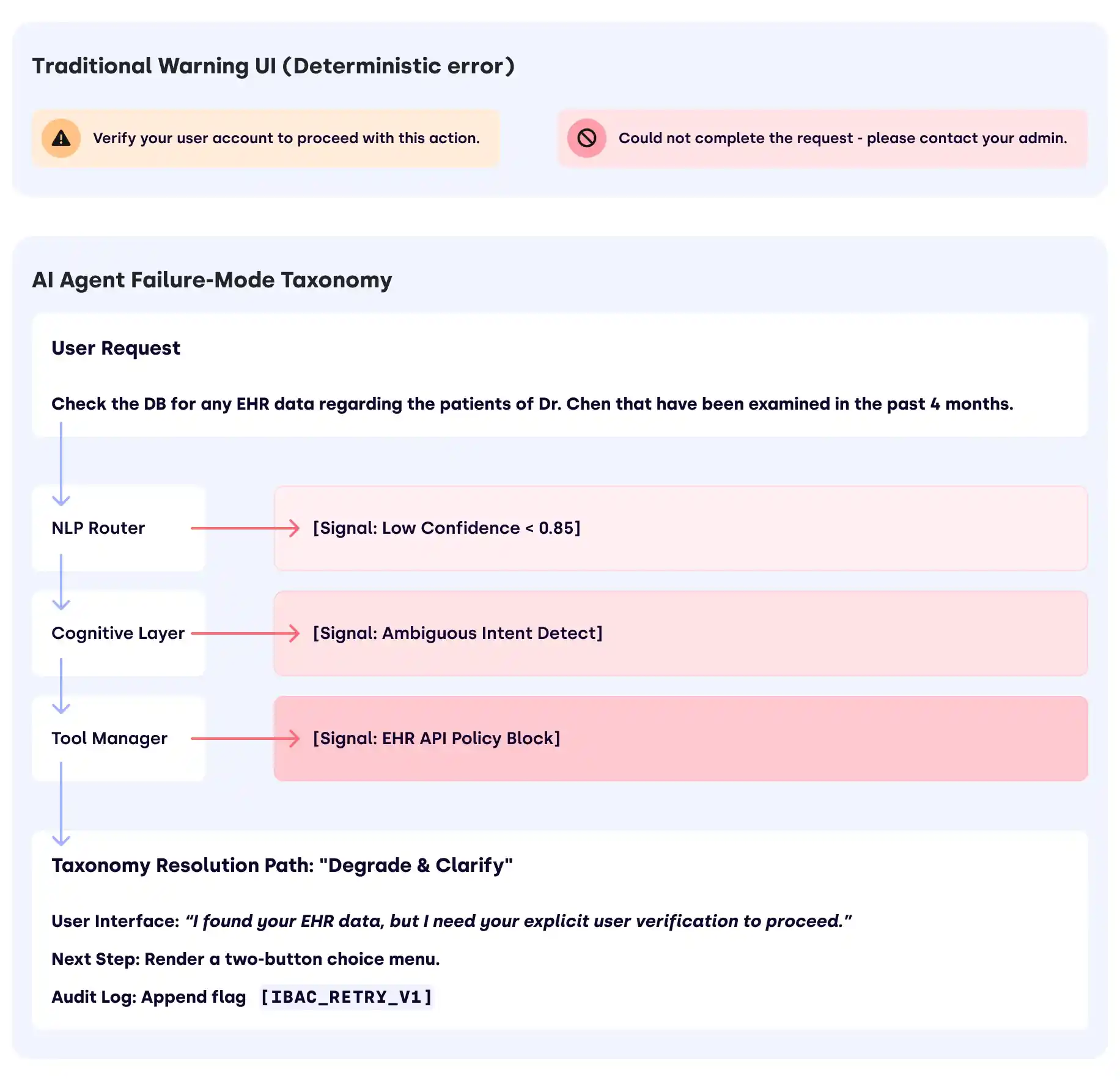
Standard UX design accounts for edge cases through validation messages, empty states, and fallback flows. AI agents fail differently because they can be wrong while still sounding convincing and authoritative. They can produce incomplete or low-confidence results, misinterpret ambiguous intent, rely on missing data, trigger the wrong tool, or continue acting past the point where a human should step in.
A Failure-Mode Taxonomy gives teams a structured way to define these risks before they emerge in production. It catalogs:
the main ways an agent can fail,
the signals that indicate each failure mode (e.g., confidence thresholds, tool errors, policy rule triggers),
what should be shown to the user,
and what the next step should be (clarify, warn, degrade gracefully, or escalate).
Designing these behaviors explicitly is how teams prevent polished interfaces from masking unsafe or unreliable automation.
In regulated workflows, this deliverable supports accountability. A Failure-Mode Taxonomy creates a common language for design, engineering, security, and compliance teams, helping define what a safe recovery path looks like, which actions must be logged, and where human review is mandatory. This is where intent becomes safe impact: you still want the system to pursue the user’s goal, but within a framework that contains risk, preserves auditability, and protects both the organization and the end user.
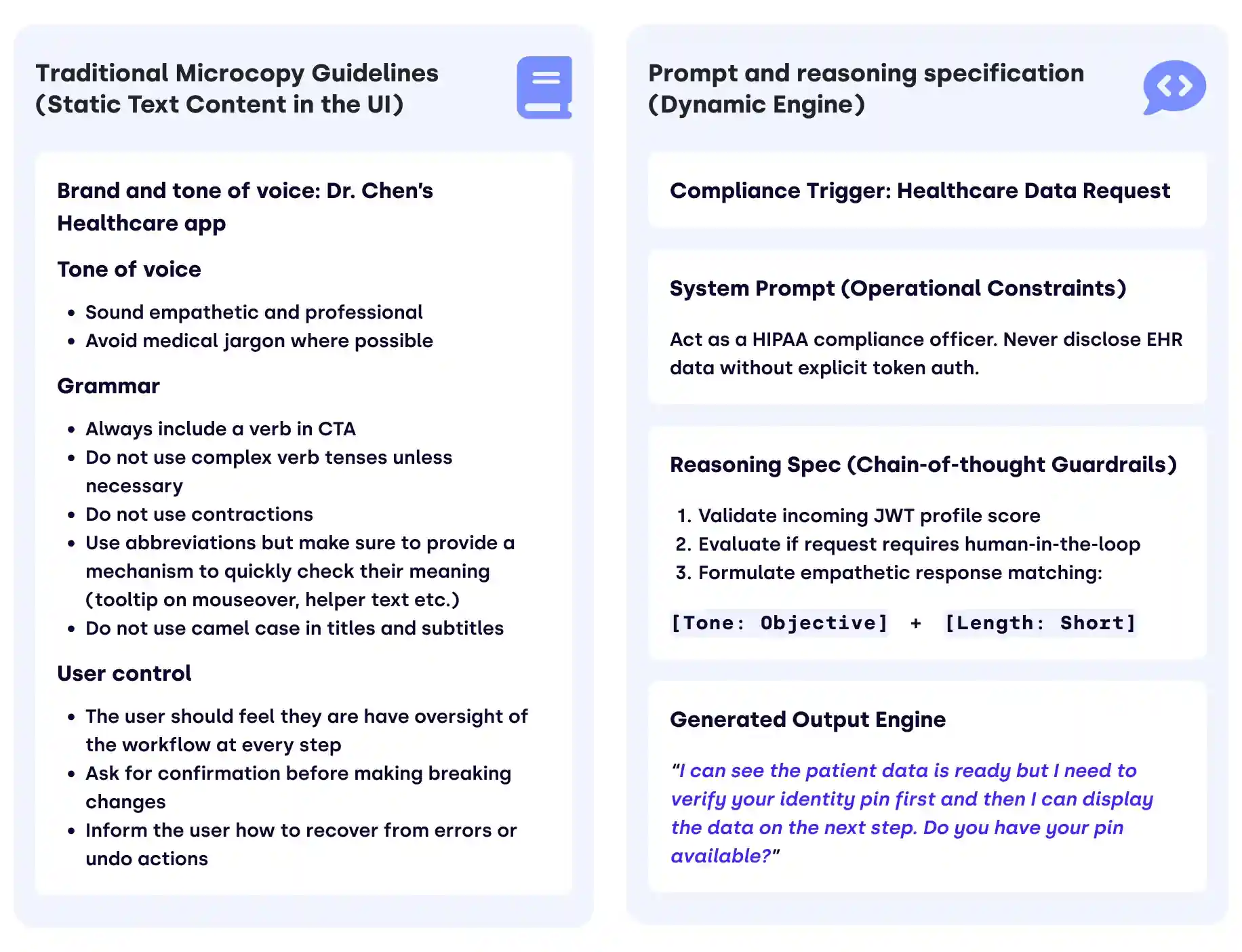
Most organizations already invest in design systems, writing, and microcopy guidelines, and interaction patterns to keep visual and verbal experiences consistent. Agentic systems require an additional layer: a specification for how the system behaves conversationally and cognitively.
A Prompt & Reasoning Spec usually combines:
the system prompt that defines the agent’s role, tone, and constraints,
a prompt pattern library for recurring tasks (summarizing, recommending, asking for clarification, refusing unsafe requests),
and a reasoning layer that determines how much of the agent’s logic and evidence is visible to the user.
Prompt & Reasoning Specs define how AI agents should sound, when to be assertive, how to express uncertainty, what evidence they surface, and how they invite human review when needed. It is not just a content artifact; it is a behavioral governance asset.
In regulated environments, this distinction is critical. Consistency in AI behavior is not only a brand concern; it is part of how safety, compliance, and trust are maintained over time. Well-designed prompts and reasoning layers make it easier for users to accept and act on agent recommendations, which directly influences adoption, utilization of autonomous workflows, and ultimately the ROI of AI investments.
Since the emergence of UX design as a discipline, the role of the UX designer has been to mediate between business goals, user needs, and technical constraints. The same pattern is replicated in the Agentic UX design approach: the designer’s role is expanding from arranging interface elements to mediating between technology, business intent, and human reality.
When working to create AI agents, designers:
model user intent rather than just interface steps,
expose where trust is likely to break,
identify moments where the product needs to explain itself, ask for confirmation, or hand control back to a person,
and ensure that the experience is not only impressive in a demo, but usable under real-world pressures.
In regulated environments, that mediation role becomes even more valuable because product quality is inseparable from oversight, authority boundaries, and the ability to intervene without friction.
Agentic UX design should not be treated as a niche specialty or a post-launch refinement. It is rapidly becoming part of the core craft of software development. As AI moves from assistant features into operational workflows, the ability to shape agent behavior around human needs will determine whether products create durable business value or simply generate short-lived hype.
Most organizations do not need to outsource every aspect of Agentic UX design. What many teams need first is a reliable framework they can use internally: a practical way to define intent, specify authority boundaries, plan for failure, and standardize how AI agents communicate and escalate.
An Agentic UX playbook built around artifacts such as Intent Maps, Failure-Mode Taxonomies, and Prompt & Reasoning Specs does more than improve design quality. It helps businesses integrate agentic thinking into the development process itself, creating stronger alignment between product, design, engineering, security, and domain stakeholders.
For organizations building in regulated contexts, that is often the difference between an interesting AI prototype and a trustworthy AI product.
In the coming years, the question for business leaders will not be whether AI agents can be added to software. That part is already underway. The real question is whether those agents can be designed to act in ways that are understandable, governable, and genuinely useful to the people they are meant to support.
Agentic UX design is one of the clearest answers emerging to that challenge because it recognizes a simple truth: reliable autonomy is not discovered by accident; it is designed, and it is designed by starting from user intent and working all the way through to measurable business impact.
Reliable autonomy starts well before deploying the first AI agent. It requires strong technical foundations, accessible data, clear governance, and a thoughtful approach to Agentic UX design.
If your organization is exploring AI-powered products or autonomous workflows, we can help assess your AI readiness, develop an Agentic UX playbook, and identify the highest-impact opportunities to turn AI capabilities into real business results.