Technology Strategy
AI Governance in the SDLC: 6 Controls for AI-Assisted Development


Every mobile application starts with a series of product decisions.
What problem are we solving? Who are we building for? Which platforms matter most? How quickly do we need to launch?
Somewhere in that conversation, another question inevitably appears: Should we build with React Native or go native?

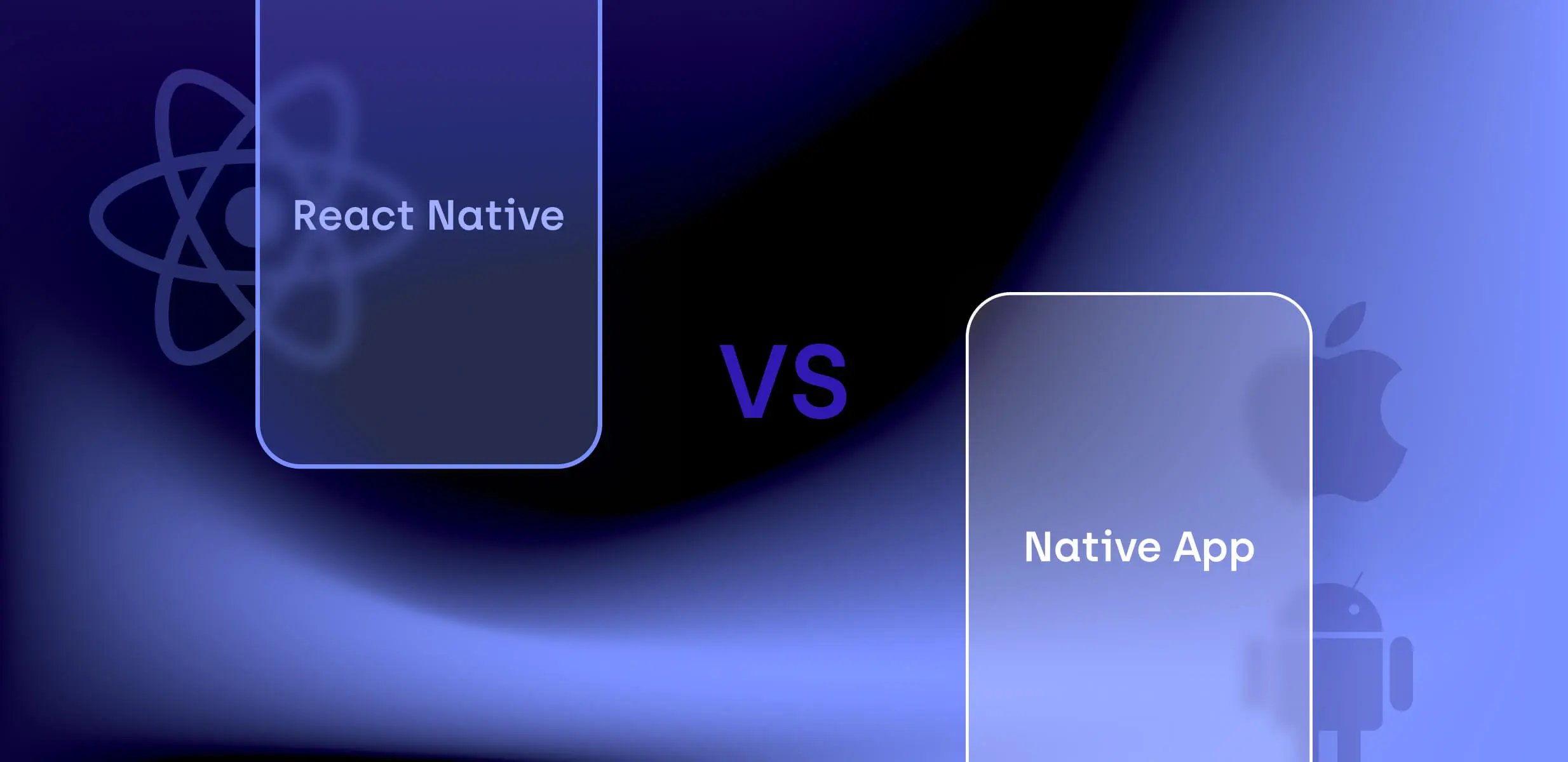
It's often treated as a purely technical decision. In reality, it influences delivery timelines, engineering effort, long-term maintenance, hiring, and how easily your product can evolve over time.
Search for "React Native vs Native" and you'll find dozens of articles comparing performance, development speed, cost, and code sharing. Those comparisons provide a useful starting point, but they rarely determine the right decision on their own. The best choice depends on your product requirements, engineering team, long-term roadmap, and the capabilities your application needs to support.
Choosing a mobile framework isn't about identifying the better technology.
It's about understanding which approach best supports the product you're trying to build.
React Native is not a web application running inside a mobile wrapper, and it does not remove native mobile development from the equation. It renders native platform components and still produces separate iOS and Android applications. Its advantage is that a meaningful portion of product logic and user-interface code can be shared, while platform-specific build configuration, signing, distribution, testing, and native integrations remain part of the engineering effort.
Product characteristic | Strong starting point |
|---|---|
Shared iOS and Android experience | React Native |
Proprietary hardware SDKs | Native |
Fast release cadence | React Native |
Newly introduced or unsupported OS APIs | Native |
Mostly shared app with a few platform-specific capabilities | Hybrid |
It's tempting to begin with technology.
Should we use React Native? Should we build separate native applications? Should we hire Swift or Kotlin developers?
Those questions matter, but they're rarely the best place to start.
Before evaluating frameworks, it's worth stepping back and looking at the product itself. Questions such as what problem the application solves, who will use it, which platforms need to be supported, and how the product is expected to evolve over time provide far more useful direction than comparing feature lists.
Technology should support the product strategy, not define it.
Many framework decisions focus on the first version of the application.
How quickly can we launch? How much will development cost? How many engineers do we need?
Those are all reasonable questions, but they're only part of the picture.
Most successful mobile applications continue evolving long after they're released. New features are introduced, operating systems change, user expectations shift, and business priorities evolve alongside them. The framework you choose today influences how easily your team can respond to those changes tomorrow.
That's why it's worth evaluating the lifetime cost of ownership, not only the initial development effort.
Development cost is usually the easiest part to estimate.
Long-term ownership is where the picture becomes more complex.
Separate native applications typically require separate codebases, platform-specific expertise, independent testing, and coordinated releases. Cross-platform development reduces some of that duplication by allowing teams to share a significant portion of the application across iOS and Android.
Neither approach is automatically less expensive.
The more useful question is how the product will be maintained over time. If your roadmap includes frequent releases across both platforms, reducing duplicated engineering effort may become increasingly valuable as the application grows. (This is the same lens worth applying to legacy systems more broadly; our digital modernization services walk through how to weigh a rewrite against incremental modernization.)
Every mobile application places different demands on the technology behind it.
A well-engineered React Native application can satisfy the performance requirements of many commerce, communication, healthcare, and internal workflow applications. Rather than asking whether React Native is "fast enough," engineering teams should evaluate measurable criteria such as startup time, scrolling smoothness, animation frame rate, memory consumption, battery usage, media processing requirements, and behavior on lower-end devices.
Native development becomes more compelling when critical workloads cannot be handled efficiently through native-backed components or when platform-specific capabilities dominate the product.
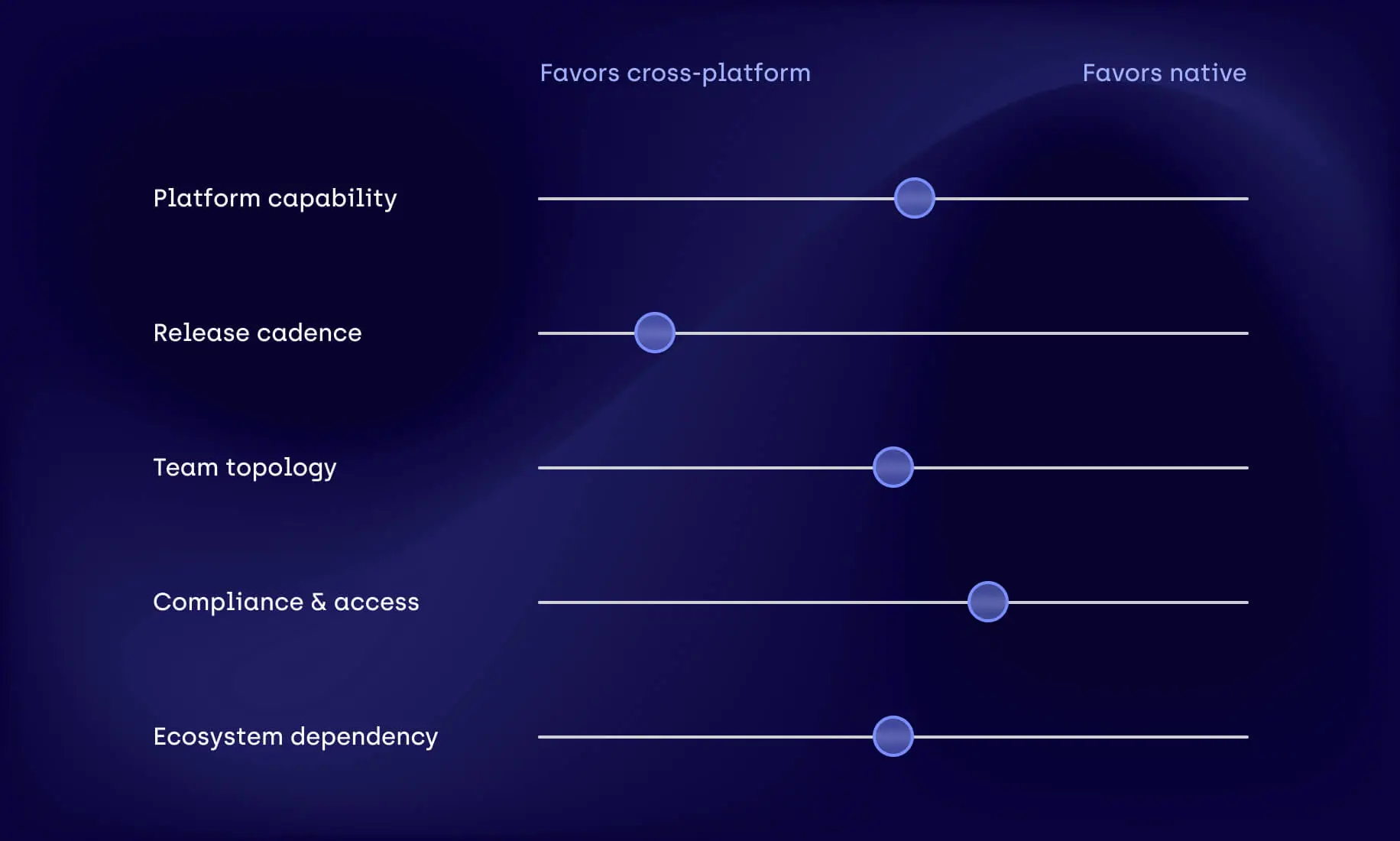
Beyond the product question, a handful of concrete dimensions tend to separate the decisions that age well from the ones that don't.
Platform-specific capability requirements.
Native development becomes more attractive when a large share of the product depends on newly released or unsupported OS APIs, app extensions and widgets, proprietary hardware SDKs, continuous background execution, real-time media or sensor processing, or strict memory, battery, and latency budgets. Standard permissions, notifications, camera access, biometrics, and secure storage are not decisive on their own, since React Native can reach native platform APIs through existing libraries or Turbo Native Modules.
Release cadence and risk tolerance.
React Native applications can support over-the-air delivery of compatible JavaScript and asset updates when an update service is included in the architecture. This can shorten the path for certain fixes, copy changes, and UI adjustments, but it does not apply to native code, native dependencies, permissions, or changes that require a new application binary, and all updates remain subject to App Store and Play Store policies. For teams that need to iterate quickly, run experiments, or patch issues on a tight timeline, that difference is still a genuine business consideration, not just a technical one.
Team topology.
The question isn't only whether your engineers know React. It's whether you're structuring one team to own both platforms, or two teams each specializing in their own. That choice shapes hiring, code review, on-call coverage, and how easily the team scales.
The hybrid path.
Few real-world decisions are fully binary. Many teams build the majority of an application in React Native and drop into Turbo Native Modules for the specific capabilities that require it: proprietary vendor SDKs without maintained React Native support, app extensions, custom media processing, specialized Bluetooth or industrial hardware, secure-element workflows, or other performance-critical native components. Framing the decision as "either/or" often overstates how the tradeoff actually plays out in practice.
Compliance and accessibility obligations.
React Native provides broad accessibility APIs that integrate with iOS and Android assistive technologies, although behavior and implementation details differ between platforms. Native development provides more direct access to newly introduced or highly specialized platform APIs, while React Native applications may require native work for certain custom components or edge cases. Neither approach removes the need for platform-specific VoiceOver and TalkBack testing, keyboard and switch-control validation, and manual accessibility audits. (For a closer look at what accessible software actually requires, see our piece on the four fundamental principles for creating inclusive and accessible software.)
Ecosystem dependency.
Native development ties a product closely to Apple and Google's platform direction. React Native introduces additional dependencies on the stewardship of the React Foundation, ongoing contributions from organizations such as Meta and Expo, the framework's release cadence, and the health of its open-source library ecosystem. The practical risks include compatibility with React Native's newer architecture, the maintenance quality of native SDK wrappers, and alignment with new iOS and Android releases. Neither path is dependency-free, so the relevant question is which dependencies the organization is best equipped to manage.
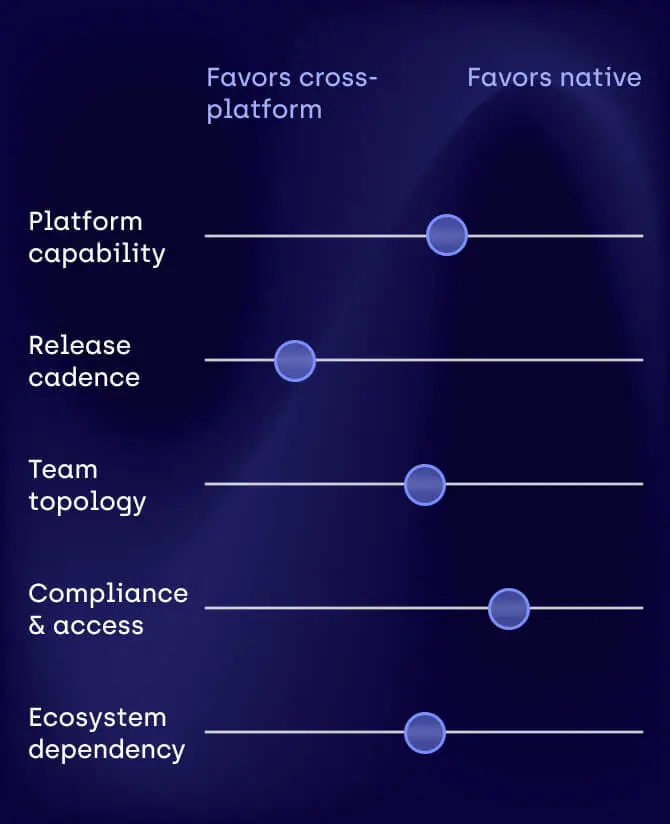
The operating model matters too. Many of the delivery advantages commonly associated with React Native depend not only on React Native itself but also on the surrounding tooling. Projects built with frameworks such as Expo often have a different build, update, and maintenance profile from bare React Native implementations with extensive custom native configuration.
Consider two hypothetical products.
The first is an internal scheduling tool for a healthcare provider. It displays appointments, sends notifications, and lets staff update records. There's little platform-specific complexity, releases happen often, and the team is small. A cross-platform approach likely reduces duplicated effort without asking the team to compromise on the experience.
The second is a fintech application that depends on a proprietary payment-terminal SDK, secure-element or NFC workflows, hardware-backed device attestation, strict background execution, and latency-sensitive device processing. Those requirements may justify native development, or a React Native application with clearly bounded Turbo Native Modules for the security-critical and platform-specific components. Biometric authentication, secure token storage, and offline data handling alone would not automatically rule out React Native.
Neither scenario is a verdict on which framework is "better." They simply illustrate how the same decision produces different answers depending on what the product actually demands.
A common concern among engineering leaders is what happens if the framework choice turns out to be wrong two or three years in.
The honest answer is that the cost depends heavily on how the application was built, not just which framework was chosen.
API contracts, backend services, domain concepts, data schemas, test scenarios, analytics definitions, and design assets may carry over into a future implementation.
React Native UI code and JavaScript or TypeScript business logic do not automatically become Swift or Kotlin code and usually need to be rewritten, unless the architecture deliberately isolates them in a portable shared layer.
The migration cost therefore depends less on abstract separation alone and more on how much source code is tied to React Native, its libraries, and its rendering model.
Rather than trying to predict the "perfect" framework years in advance, it's often more valuable to design the application so that future migration costs remain manageable if business or technical priorities change.
Technology decisions don't happen in isolation.
The experience, structure, and availability of your engineering team all influence what makes sense for a project.
Consider questions such as:
Does your organization already have React expertise?
Will one team maintain both mobile platforms?
Will development be handled internally or by an external partner?
How easy will it be to grow the engineering team as the product evolves?
These questions won't determine the answer on their own.
They do, however, influence how sustainable a mobile product will be over the long term, often more than benchmark comparisons ever could.
Talent availability is worth weighing here too, with a caveat.
In some markets, React and JavaScript talent may be easier to source than engineers with deep Swift or Kotlin specialization.
However, web React experience is not equivalent to production React Native expertise.
A sustainable React Native team still needs mobile engineering knowledge across native build systems, application lifecycle, signing and distribution, platform debugging, performance, accessibility, operating-system conventions, and the ability to work comfortably across both JavaScript and native platform code when required.
It's worth noting that certain costs exist no matter which path you choose.
Quality assurance, accessibility, design system consistency, security review, and app store compliance all require investment whether the application is built natively or cross-platform.
The framework decision shapes engineering effort; it doesn't eliminate the surrounding discipline a mobile product still needs.
For teams wanting to go deeper specifically on where React Native fits and where it doesn't, our whitepaper, The 360-degree guide to building a mobile app with React Native, walks through the business scenarios the technology is well suited for, the cases where it isn't the right choice, and a four-stage process for bringing a React Native app to market.
React Native is usually the stronger starting point when:
the product targets both iOS and Android;
the core user experience is largely shared;
release cadence matters;
the required native capabilities are covered by maintained libraries or clearly bounded Turbo Native Modules.
Native development is usually the stronger choice when:
platform-specific behavior is central to the product;
the application depends heavily on unsupported or newly introduced operating-system APIs;
strict latency, graphics, memory, battery, background execution, or hardware requirements dominate the architecture.
A hybrid approach is appropriate when most of the product can be shared, but a small number of well-defined capabilities require native implementation.
React Native can be used in regulated products, but the framework itself does not provide security or regulatory compliance. Sensitive business rules, privileged credentials, and authoritative transaction processing should remain on the server rather than being embedded in either JavaScript or native client code. Tokens and cryptographic keys should use platform security mechanisms such as iOS Keychain and Android Keystore, while capabilities such as biometrics and device attestation can be accessed through vetted native-backed APIs.
Ultimately, architecture, secure development practices, dependency governance, and auditability have a far greater impact on security than the choice between React Native, Swift, or Kotlin.
Not necessarily. Some organizations maintain one team with cross-platform expertise in both Swift and Kotlin, while others split ownership by platform. What matters is deciding this deliberately rather than letting it happen by default, since it affects hiring, code review, feature consistency, and long-term ownership.
Often, yes. See "What a later migration actually costs" above for what typically carries over and what doesn't. In short, separating business logic from the presentation layer and minimizing framework-specific coupling can significantly reduce the effort required if that migration becomes necessary.
It depends on what "demanding" means for your product. See "Consider the experience you're trying to deliver" above for the criteria worth evaluating. As a rule of thumb, native development becomes more compelling when those requirements can't be met efficiently through React Native and native-backed components.
It's worth remembering that this doesn't have to be a single, irreversible bet made on day one.
Many teams reduce the risk of a framework decision by first prototyping the part of the application that carries the most uncertainty, whether that's a specific hardware integration, a performance-sensitive workflow, or a platform-specific capability. Testing the riskiest assumption before committing to a full implementation often provides more confidence than extended debate or theoretical comparisons.
Treating the decision as iterative, rather than one-shot, tends to produce better outcomes than trying to identify a permanent answer during planning.
Before finalizing a direction, it's worth working through a short set of questions with your team:
What platform-specific capabilities does this product genuinely require, now and on a two-year horizon?
How often do we expect to release, and how much does release friction cost us?
Are we prepared to staff one cross-platform team, or two platform-specific teams, and which fits how we already work?
If a hybrid approach makes sense, which specific components would justify native implementation?
If we needed to migrate in two years, how much of what we're building today would carry over?
There isn't a single right answer to any of these questions. But answering them deliberately, and validating the highest-risk assumptions early, will almost always lead to a better long-term decision than choosing a framework based on familiarity or industry trends alone.